
By Mark Anderson
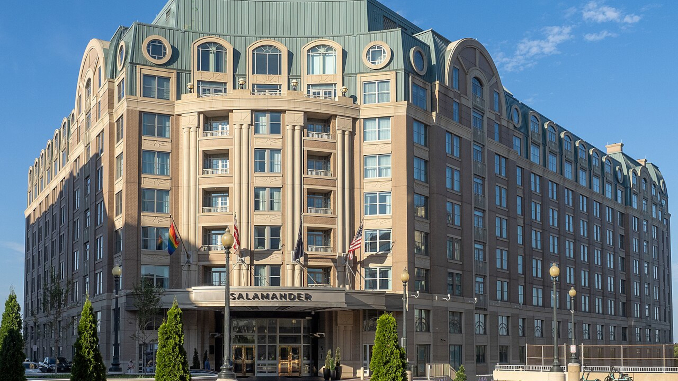
Several of President Donald Trump’s top cabinet-level appointees attended this year’s Bilderberg meeting in Washington D.C., held at the Salamander Hotel over the weekend of April 9-12.
Click the Link Below to Listen to the Audio of this Article
Major financial and trade shifts made up a significant part of this invitation-only, secretive confab of various foreign figures from the upper echelons of the public and private sectors. Also, there was considerable discussion over the groundwork for an even more digitized world economy.

Intersections between such economic digitalization, artificial intelligence (AI), and defense concepts and systems became unmistakably evident with the continued attendance of Palantir Technologies CEO Alex Karp, an American upper-level Bilderberg insider who has been riding a Bilderberg-abetted wave of major Pentagon contracts for expanding AI automated warfare systems and other projects, as well as Relativity Space (aerospace) American CEO Eric Schmidt; and U.S. Army Secretary Daniel Driscoll.
Driscoll, much to Karp’s liking, strongly supports drone warfare and unmanned systems—all of which fit neatly into the 2026 Bilderberg topic “Future of Warfare,” one of 14 official topics this year in all. He is the youngest secretary in U.S. history and is known for having visited Ukraine’s leadership, unannounced in November 2025, to try and establish peace with Russia, reports claim.
That, in turn, ties into Ukraine as another Bilderberg topic this year—a topic every year in recent memory.
The same goes for Russia, another relevant 2026 topic that has been on the Bilderberg agenda for several years. Ditto for China.
Others involved in this digital economy-AI-defense intersection who attended Bilderberg 2026 include Google’s British DeepMind CEO Demis Hassabis; Scale AI’s U.S.-born CEO Alexandr Wang; Open AI’s Albanian Chief Technology Officer Mira Murati; Anthropic’s British co-founder Jack Clark; Mistral AI’s French CEO Arthur Mensch; and Sage Works’ American CEO Stacey Abrams.
A key attendee enmeshed in financial-digital matters is a relative newcomer, Stripe CEO Patrick Collison of Ireland, whose digital-payment processing company could be a major winner via Bilderberg-wrought inside deals in an increasingly digital economy.

A perennial Bilderberg elder who returned once again is American KKR investment chief Henry Kravis, whose wife Marie co-chairs the Bilderberg Steering Committee and is on the board of the American Friends of Bilderberg—a tax-exempt nonprofit “charity.” Kravis has reportedly shown considerable interest in the “Trans-Atlantic Defense Industrial Relationship”—yet another 2026 Bilderberg official topic.
While Kravis sees Europe as a good strategic investment area for defense infrastructure and the associated technology—right when NATO member nations have pledged to spend more on defense and rely less on the United States at President Trump’s urging—KKR is evidently involved in exclusive talks to co-develop a large data center on an as-yet-to-be-announced Army base.
No doubt, Driscoll’s attendance alongside Kravis at Bilderberg can help tie up any loose ends.
The 2026 topic “Europe,” vague though Bilderberg topics often are, likely comes into play along these lines.
BESSENT, FRENCH COLLABORATE
A routine news release from the office of Treasury Secretary Scott Bessent revealed that he met in Washington with French Minister of Economy Roland Lescure on April 14, about 48 hours after the Bilderberg Meeting concluded.
The April 15 news release that Bessent’s office released about his meeting with Lescure failed to note, however, that the two gentlemen had already met together behind closed doors at the 72nd-ever Bilderberg Meeting—strongly suggesting that their “public” meeting was a mere formality to consummate what already had been smoothed out secretly at Bilderberg.

Lescure’s full title is minister for economy, finance and industrial, energy and digital sovereignty—which, along with other aforementioned items, ties into two more announced Bilderberg topics for 2026—“Digital Finance” and “Energy Diversification.”
The first of those topics unavoidably relates to the advancement of central bank digital currencies to move the world toward a cashless, fully digitized economy, something that Bilderberg-associated think tanks have studied.
In a notable shift, neither the Atlantic Council nor the Council on Foreign Relations sent representatives to Bilderberg this year. Greater think-tank involvement is coming from Stanford University’s Hoover Institution, as well as the D.C.-based Hudson Institute—which has studied the defense, economics, energy and technology matters on the Bilderberg to-do list this year.
The Treasury news release officially stated that Bessent met with Lescure “to discuss cooperation on critical minerals, including in the context of France’s leadership of the 2026 G7 Meetings,” to take place June 15-17 in Evian, France.
The news release stated:
The secretary noted upcoming discussions at the G7 and G20 regarding global imbalances and highlighted his strong support for [the] upcoming G20 event on promoting financial literacy. Secretary Bessent also pressed France to lead the European Union’s efforts on pressuring Iran to end its destabilizing threat.
In light of the 2026 Bilderberg topics “the Middle East” and “Future of Warfare,” Bessent seems keen on getting the European Union more actively involved in the business of warfare in the Middle East. Trump—who met in Washington with annual Bilderberg attendee and NATO Secretary General Mark Rutte just before Bilderberg 2026 started—has been equally interested in prodding NATO to take a more active role in assisting the United States—and by extension Israel—in its warfare strategy against the Islamic Republic of Iran.
The G20 meeting was set to happen much sooner than the G7 in April 2026. Bessent has been highlighting that the G20 should “improve economic resilience” via a “G20 Fireside Chat on Global Financial Literacy.” That chat, according to what the public is being told, will focus on “financial health, digital assets, and consumer protection.”

Bessent was set to conduct that fireside chat with World Bank President Ajay Banga and with Queen Maxima of the Netherlands. She attended the 2026 Bilderberg Meeting—her first time ever at Bilderberg—although her mother-in-law Queen Beatrix attended Bilderberg for several straight years.
Queen Maxima has been serving as the UN secretary general’s special advocate for financial health ever since 2009. She frequently takes part in discussions at the annual spring meetings of the World Bank and International Monetary Fund and supports what’s called “green finance” as well as economic “solutions” regarding a digital economy.
The overall Dutch delegation included Rob Jetten, apparently the only sitting prime minister to officially attend Bilderberg 2026.
MEDIA MATTER CONCLUDES
Another person of interest is regular Bilderberg attendee and German national Mathias Dopfner. As chief of the Axel Springer SE media group, which owns Washington, D.C. daily news outlet Politico, Dopfner just received a favorable outcome in his bid to purchase the UK’s Daily Telegraph newspaper. Did that happen via his Bilderberg connections, which includes his Steering Committee membership?
Dopfner’s purchase of the Daily Telegraph for $766 million followed a three-year bidding war, yet the deal was approved by the United Kingdom government on April 14—just two days after the earlier-than-ever 2026 Bilderberg conference concluded.
CONGRESS MEMBERS
Other high-profile attendees included Rep. Jason Smith (R-Mo.), who heads the trade-and-tariff policymaking House Ways and Means Committee. Smith showed up at Bilderberg for the second straight year alongside House newcomer Rep. Terri Sewell (D-Ala.).
Besides Bessent, other high-level current and former Trump appointees included U.S. Trade Rep. Jamieson Greer and former Trade Rep. Robert Lighthizer, who’s now with the Center for American Trade.
This explains why “Global Trade” was another of the official topics this year.
Most sources, including the Office of the Trade Representative itself, say that the general direction of U.S. global trade policy is to keep building what U.S. officials claim is an “America-first” model comprised of protectionist measures and bilateral rather than multilateral trade agreements, with considerable emphasis on boosting domestic manufacturing. There have also been statements on reducing U.S. reliance on the World Trade Organization.

While some have interpreted the Trump administration’s significant Bilderberg presence as a means of the U.S. re-directing various globalist systems in a direction favorable to America, others see it as a possible U.S. sellout to the globalist system that could ultimately betray American citizens.
AFP will keep monitoring Bilderberg-related developments, whatever the ultimate outcomes may be.
Mark Anderson is a roving writer for AFP. He invites your thoughtful comments and story ideas at [email protected]. Mark’s radio show “Stop the Presses!” runs at www.republicbroadcasting.org, Thursdays from 2 to 3 p.m. EDT.

Leave a Reply